One of my favorite speakers on all issues education, Sir Ken Robinson, speaks below about the current system of education and how it is actually providing a disservice to the children of America. Specifically, he addressed the fact that children's creativity (which has been recorded at genius levels in kindergartners) is suppressed by the standardized and industrial-model system of education.
It's ironic that I watched this video recently, because just a week ago I had stumbled upon another speech by Robinson on the TED Talks website. The speech below also resonates of his urge to spark a dramatic shift in the way we view education, and he cites specific examples in which kids' creativity is lost upon educators, who are looking to produce cookie-cutter students.
If you're like me, then you found both of these videos inspiring. Truly, there are so many domains to education I could get into regarding the issues brought up by Robinson, but since this is a blog about technology in an L2 classroom, I'll limit my thoughts a bit.
One of the strongest points Robinson brings up is the fact that we are supposed to be educating and preparing students for a society that no one can predict. So why is the content of what we are teaching 99% past? And I don't mean history classes. I'm talking about things like the English literature canon and the lack of technology-focused classes. Only a small percentage of ELA classes focus on contemporary literature--works being written today, by today's generation, and technology courses are rarely part of the core curriculum.
Change takes time, and I don't expect radical changes to be made to state standards and core curriculum for a while, but as teachers we need to look out for the welfare of our students today. This means implementing meaningful technology in early classes as often as possible. In today's world, literacy doesn't mean just the ability to read and write. It describes a way of thinking, of problem solving. To foster the development of literacy in our students, we need to break away from the textbook, from the pen and paper, and start using digital means by which students can read, write, share, think, organize, collaborate, and most importantly, create.
Lastly, I want to address a concept Robinson talks about, and that is the whole learner. I feel that as content-specialty teachers, our focus is much to narrow. If a student in my class is struggling with one specific subject or skill, I must ask myself more than just "What can I do to help him/her in this skill?" I must extend my perspective by looking at the student as a whole, including his/her strengths and weaknesses in other subjects, outside influences such as home life, and the students' interests. Most likely, the answer to my original question lies somewhere in these other areas. When we limit our focus to the content, we ignore the student, which should always be the true focus of our goals.
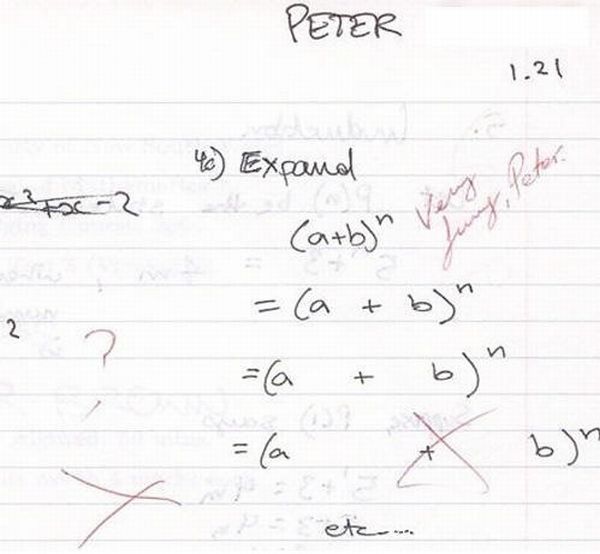
Just to make you think...



1 comment:
The end of your post made me laugh out loud. I love the "find the x" example in particular.
The first part of your post made me think of how we need to teach multiple literacies. Students today need to learn how to produce projects using blogs, wikis, podcasts, videos, etc. While they may be familiar with these tools, they are often not allowed to use these for academic purposes, but, I'm sure many of them could produce fantastic projects!
Sir Ken Robinson is also one of my favorite speakers and I wish I could spend some time everyday just watching TED talks. They are just so well done and contain such fascinating ideas!
Post a Comment